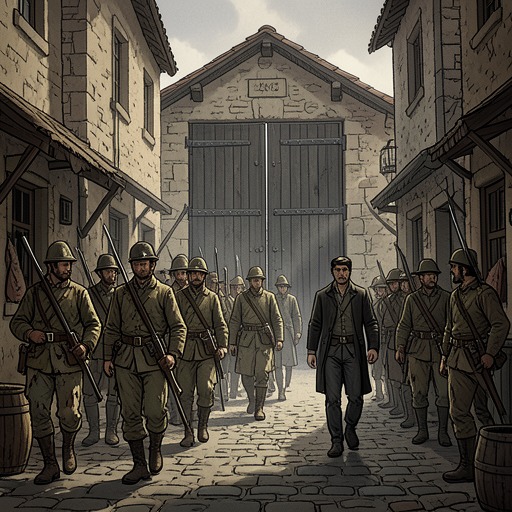
Siege of Wark Castle (1385)
The Last DuelThe Siege of Wark Castle (1385) was a costly assault in the French campaign into England: the attackers overcame a strongly defended fortress, only to destroy it because they could not safely keep it. Its course exposed the limits of a fast-moving raiding force, which could take a castle by force but lacked the means to make it a lasting possession.
Causes and Defenses
The French and Scots reached Castle Wark during their southward advance through England. The fortress stood on a rocky outcrop above the Tweed. Its four-story keep had stone vaults around its entrance and five openings in the walls through which defenders could attack those below. Sir John Lussebourne, who was inside with his wife and children, had been forewarned and strengthened the garrison. Cannons and crossbows guarded the battlements, while ditches around the castle slowed attackers and exposed them to fire from above.
Admiral Vienne sent a herald to demand Sir John’s surrender, threatening a siege if he refused. Sir John answered from the walls with insults and a warning that Vienne should withdraw before being caught by the Scots’ treachery. The exchange closed the possibility of surrender; the assault began soon afterward.
The Assault and Capture
The attackers had no trebuchets to hurl heavy stones over the walls, and their small portable cannons could not break the thick masonry. Castle Wark’s rock foundation also prevented them from tunneling beneath its walls. Nor could they wait for hunger to weaken the well-provisioned garrison: the campaign’s need for speed left no time for a prolonged blockade.
Vienne therefore ordered an escalade. His men lashed long poles together as ladders and tried to climb the walls, where the defenders met them in close combat. The French renewed their attacks, while crossbowmen positioned around the fortress steadily targeted the English garrison. The Scots, despite having marched with the French into England, refused to take part in the siege. The attackers eventually entered the castle and captured Sir John, his family, and the other defenders. The first French inside took more than forty prisoners.
Destruction and Significance
Victory did not make Castle Wark a usable stronghold. The French judged that, so far advanced in England, they could neither keep nor guard it. They burned and destroyed the fortress rather than leave it as a position they could not defend. The outcome thus joined capture to abandonment: the assault achieved its immediate military objective, but the campaign’s haste and distance from secure support prevented the attackers from turning possession into control.